For the first time in the history of planet Earth, in the history of consciousness, a World Spirituality is utterly possible and utterly necessary. A World Spirituality is one that trance-ends. It ends the trance of any particular religion or nationality. It weaves together the best medicines of every great system of knowing into a larger whole.
The most urgent need we have today is to participate in the gathering of all of us who want to participate in this great evolutionary unfolding. It’s already happening all over the world.
Showing posts with label evolution. Show all posts
Showing posts with label evolution. Show all posts
4/11/12
Marc Gafni on the possibility and necessity of a World Spirituality
Excerpt from the blog "Spirit's Next Move"


9/26/11
Gaming to save the world problems. Blissful Productivity.
500 million gamers now. 1.5 Billion gamers in the next decade. Gamers always believe in the possibility of an epic win. Gamers are super-empowered, hopeful individuals.
Use these skills to solve real world problems.
8/10/11
Spirit Exploration in the Modern Age
I am excited to attend three great expansive events in the coming year.
Wisdom 2.0 Youth
Sept 17 2011
Computer History Museum in Mountain View, California
Integral Spiritual Experience 3 (ISE3)
Dec 28 - Jan 1
Pacific Grove, Ca
This extraordinary event is the largest Integral Spiritual practice event ever created. Featuring over 60 hours of live event content including keynote addresses, plenary sessions, morning & evening practice sessions, entertainment & live performances, large and small group activities and shared meals. ISE 3 curriculum and design is held within the integral spiritual framework – the most inclusive and robust evolutionary spiritual teaching humanity has ever produced.
Wisdom 2.0 Conference
Feb 23 - 26 2012
Mountain View, Ca
The Wisdom 2.0 Conference is a one-of-a-kind event in Silicon Valley that brings together people from a variety of disciplines, including technology leaders, Zen teachers, neuroscientists, and academics, to explore how we can live with deeper meaning and wisdom in our technology-rich age.
The conference addresses the great challenge of our age: to not only live connected to one another through technology, but to do so in ways that are beneficial to our own well-being, effective in our work, and useful to the world.
Wisdom 2.0 Youth
Sept 17 2011
Computer History Museum in Mountain View, California
Teachers, educators, parents, mindfulness teachers, and others discuss the need to balance the "inner technologies" of wisdom, awareness, and compassion with cell phones, computer games, and social networks.
While pushing away and renouncing all modern technology is seen as pointless and unnecessary, likewise does a life where family members spends the majority of each evening glued to their individual screens, and where kids cannot sit still and need constant external stimuli to keep them entertained.
The Wisdom 2.0 Youth Conference explores this balance and asks the question,
"How do adults embody the very qualities we want to pass along to the youth in our life?"
Integral Spiritual Experience 3 (ISE3)
Dec 28 - Jan 1
Pacific Grove, Ca
This extraordinary event is the largest Integral Spiritual practice event ever created. Featuring over 60 hours of live event content including keynote addresses, plenary sessions, morning & evening practice sessions, entertainment & live performances, large and small group activities and shared meals. ISE 3 curriculum and design is held within the integral spiritual framework – the most inclusive and robust evolutionary spiritual teaching humanity has ever produced.
Identify and examine major stages of evolutionary creativity as it manifests in individuals and in the larger integral community.
Examine how creativity arises when we begin to disengage from the mind, yet requires the skills that only a disciplined mind can cultivate.
Discover the many facets of personal and collective creativity, and look at the way creativity manifests in the evolution of consciousness itself."Be my creative partner in the healing and transformation of the world. Evolve consciousness, and fix the broken places with Me – because I cannot do it without you. I need your service. My gift to you in love," whispers God in our ear even as She caresses our heart, "My gift to you is to make you my partner and allow Myself to be – at least in part – dependent on you!" - Marc Gafni
Explore how creativity appears to a visual artist, a musician, a writer, or any other artistic pursuit.
Explore the nature of integral creativity and how ideas actually emerge from integral consciousness.
Wisdom 2.0 Conference
Feb 23 - 26 2012
Mountain View, Ca
The Wisdom 2.0 Conference is a one-of-a-kind event in Silicon Valley that brings together people from a variety of disciplines, including technology leaders, Zen teachers, neuroscientists, and academics, to explore how we can live with deeper meaning and wisdom in our technology-rich age.
The conference addresses the great challenge of our age: to not only live connected to one another through technology, but to do so in ways that are beneficial to our own well-being, effective in our work, and useful to the world.
3/20/11
5/1/10
Oregon Takes a Lesson from Google, Puts Apps in Schools
Why not? It's free and easy. Dumping Microsoft products could save a lot of money for broke school districts.
Schools in Oregon will soon have the option to embrace homework, lessons plans, and lectures in the cloud. The state is the first to adopt Google Apps for Education in all of its public schools, Google announced Wednesday.
Starting today, all school districts in the state will offer access to Google Apps – including Docs, Sites, Video, and Groups – to all teachers, staff, and students. The suite will also include e-mail filtering and protection from Postini, shared contacts via Google Contacts, Google Calendar, private online discussion groups via Google Groups, Google Talk, and iGoogle.
Article

4/30/10
Imagining the Internet
In an online survey of 895 technology stakeholders’ and critics’ expectations of social, political and economic change by 2020, fielded by the Pew Research Center’s Internet & American Life Project and Elon University’s Imagining the Internet Center. Here is an overview of the results:
Google won’t make us stupid: 76% of these experts agreed with the statement, “By 2020, people’s use of the Internet has enhanced human intelligence; as people are allowed unprecedented access to more information they become smarter and make better choices. Nicholas Carr was wrong: Google does not make us stupid.” Some of the best answers are in Part 1 of this report.
Reading, writing, and the rendering of knowledge will be improved: 65% agreed with the statement “by 2020 it will be clear that the Internet has enhanced and improved reading, writing and the rendering of knowledge.” Still, 32% of the respondents expressed concerns that by 2020 “it will be clear that the Internet has diminished and endangered reading, writing and the rendering of knowledge.” Some of the best answers are in Part 2 of this report.
Innovation will continue to catch us by surprise: 80% of the experts agreed that the “hot gadgets and applications that will capture the imaginations of users in 2020 will often come ‘out of the blue.’” Some of the best answers are in Part 3 of this report.
Respondents hope information will flow relatively freely online, though they expect there will be flashpoints over control of the Internet. Concerns over control of the Internet were expressed in answers to a question about the end‐to‐end principle. 61% responded that the Internet will remain as its founders envisioned, however many whoagreed with the statement that “most disagreements over the way information flows online will be resolved in favor of a minimum number of restrictions” also noted that their response was a “hope” and not necessarily their true expectation. 33% chose to agree with the statement that “the Internet will mostly become a technology where intermediary institutions that control the architecture and …content will be successful in gaining the right to manage information and the method by which people access it.” Some of the best answers are in Part 4 of this report.
Anonymous online activity will be challenged, though a modest majority still think it will possible in 2020: There more of a split verdict among the expert respondents about the fate on online anonymity. Some 55% agreed that Internet users will still be able to communicate anonymously, while 41% agreed that by 2020 “anonymous online activity is sharply curtailed.”

Google won’t make us stupid: 76% of these experts agreed with the statement, “By 2020, people’s use of the Internet has enhanced human intelligence; as people are allowed unprecedented access to more information they become smarter and make better choices. Nicholas Carr was wrong: Google does not make us stupid.” Some of the best answers are in Part 1 of this report.
Reading, writing, and the rendering of knowledge will be improved: 65% agreed with the statement “by 2020 it will be clear that the Internet has enhanced and improved reading, writing and the rendering of knowledge.” Still, 32% of the respondents expressed concerns that by 2020 “it will be clear that the Internet has diminished and endangered reading, writing and the rendering of knowledge.” Some of the best answers are in Part 2 of this report.
Innovation will continue to catch us by surprise: 80% of the experts agreed that the “hot gadgets and applications that will capture the imaginations of users in 2020 will often come ‘out of the blue.’” Some of the best answers are in Part 3 of this report.
Respondents hope information will flow relatively freely online, though they expect there will be flashpoints over control of the Internet. Concerns over control of the Internet were expressed in answers to a question about the end‐to‐end principle. 61% responded that the Internet will remain as its founders envisioned, however many whoagreed with the statement that “most disagreements over the way information flows online will be resolved in favor of a minimum number of restrictions” also noted that their response was a “hope” and not necessarily their true expectation. 33% chose to agree with the statement that “the Internet will mostly become a technology where intermediary institutions that control the architecture and …content will be successful in gaining the right to manage information and the method by which people access it.” Some of the best answers are in Part 4 of this report.
Anonymous online activity will be challenged, though a modest majority still think it will possible in 2020: There more of a split verdict among the expert respondents about the fate on online anonymity. Some 55% agreed that Internet users will still be able to communicate anonymously, while 41% agreed that by 2020 “anonymous online activity is sharply curtailed.”
2/21/10
The little folk of Flores
How a hobbit is rewriting the history of the human race
The discovery of the bones of tiny primitive people on an Indonesian island six years ago stunned scientists. Now, further research suggests that the little apemen, not Homo erectus, were the first to leave Africa and colonize other parts of the world.
According to a growing number of scientists, Homo floresiensis is probably a direct descendant of some of the first apemen to evolve on the African savannah three million years ago. These primitive hominids somehow travelled half a world from their probable birthplace in the Rift Valley to make their homes among the orangutans, giant turtles and rare birds of Indonesia before eventually reaching Flores.

The discovery of the bones of tiny primitive people on an Indonesian island six years ago stunned scientists. Now, further research suggests that the little apemen, not Homo erectus, were the first to leave Africa and colonize other parts of the world.
According to a growing number of scientists, Homo floresiensis is probably a direct descendant of some of the first apemen to evolve on the African savannah three million years ago. These primitive hominids somehow travelled half a world from their probable birthplace in the Rift Valley to make their homes among the orangutans, giant turtles and rare birds of Indonesia before eventually reaching Flores.
10/30/07
6/5/07
Beyond Bush
By Fareed Zakaria
Newsweek
It is time to stop bashing George W. Bush. We must begin to think about life after Bush—a cheering prospect for his foes, a dismaying one for his fans (however few there may be at the moment). In 19 months he will be a private citizen, giving speeches to insurance executives. America, however, will have to move on and restore its place in the world. To do this we must first tackle the consequences of our foreign policy of fear. Having spooked ourselves into believing that we have no option but to act fast, alone, unilaterally and pre-emptively, we have managed in six years to destroy decades of international good will, alienate allies, embolden enemies and yet solve few of the major international problems we face.
article
Newsweek
It is time to stop bashing George W. Bush. We must begin to think about life after Bush—a cheering prospect for his foes, a dismaying one for his fans (however few there may be at the moment). In 19 months he will be a private citizen, giving speeches to insurance executives. America, however, will have to move on and restore its place in the world. To do this we must first tackle the consequences of our foreign policy of fear. Having spooked ourselves into believing that we have no option but to act fast, alone, unilaterally and pre-emptively, we have managed in six years to destroy decades of international good will, alienate allies, embolden enemies and yet solve few of the major international problems we face.
article
4/23/07
webby
Yahoo!, The Huffington Post and Slate announced today plans to host two online-only presidential debates during the 2008 campaign. These first-of-their kind debates will be hosted on all three Web sites and give voters the opportunity to ask questions directly to the candidates, participate in the debate in real-time, and even determine which candidate is giving the best performance. The debates, scheduled to take place after Labor Day, will be hosted by PBS' Charlie Rose. The Democratic debate will feature opening remarks by DNC chair Howard Dean.
"We intend for these debates to be a groundbreaking mix of old and new traditions in politics," said Charlie Rose. "2008 will be a momentous year for the electoral process in America, thanks in large part to technology and politics connecting like never before. I am proud to host the first ever online only debate, which will reach and engage the voting audience in a whole new way."
"With presidential candidates announcing online and with campaign ads and fundraising increasingly online, presidential campaigns are moving to the Internet at breakneck speed. Online debates are the inevitable next step," said Arianna Huffington, co-founder and editor-in-chief of The Huffington Post. "We are thrilled to be joining with Internet pioneers Yahoo! and Slate to host the first online presidential debates, and to have Charlie Rose as our moderator. These debates represent a further merging of new media technology and politics, and are a great opportunity to bring more people into the political process, and engage the new generation of young voters who spend so much of their time -- and get so much of their information -- online."
There will be two online-only debates, one for Democrats and one for Republicans, with invitations extended to candidates who have formally announced their candidacies. These online debates will allow the candidates to participate from whatever location they choose, brought together live via the Internet, and will feature real-time questions sent in by the online audience, as well as viewer questions uploaded on video.
"The 2008 campaign is going to unfold on the Web in a way no previous election ever has," said Jacob Weisberg, editor of Slate. "We hope these first online debates will be a breakthrough, both in terms of technology and political communication. The candidates will be able to have a real discussion in real time -- but without having to be in the same place. We think the Internet can bring the same kind of immediacy to presidential debates that it has to other aspects of the political process."
"We're opening the doors of democracy for American voters to participate in the Presidential debates like never before," said Scott Moore, head of news and information, Yahoo!. "Armchair politics will take on new meaning this election season, as we're offering voters the opportunity to ask the candidates what's on their mind."
article
"We intend for these debates to be a groundbreaking mix of old and new traditions in politics," said Charlie Rose. "2008 will be a momentous year for the electoral process in America, thanks in large part to technology and politics connecting like never before. I am proud to host the first ever online only debate, which will reach and engage the voting audience in a whole new way."
"With presidential candidates announcing online and with campaign ads and fundraising increasingly online, presidential campaigns are moving to the Internet at breakneck speed. Online debates are the inevitable next step," said Arianna Huffington, co-founder and editor-in-chief of The Huffington Post. "We are thrilled to be joining with Internet pioneers Yahoo! and Slate to host the first online presidential debates, and to have Charlie Rose as our moderator. These debates represent a further merging of new media technology and politics, and are a great opportunity to bring more people into the political process, and engage the new generation of young voters who spend so much of their time -- and get so much of their information -- online."
There will be two online-only debates, one for Democrats and one for Republicans, with invitations extended to candidates who have formally announced their candidacies. These online debates will allow the candidates to participate from whatever location they choose, brought together live via the Internet, and will feature real-time questions sent in by the online audience, as well as viewer questions uploaded on video.
"The 2008 campaign is going to unfold on the Web in a way no previous election ever has," said Jacob Weisberg, editor of Slate. "We hope these first online debates will be a breakthrough, both in terms of technology and political communication. The candidates will be able to have a real discussion in real time -- but without having to be in the same place. We think the Internet can bring the same kind of immediacy to presidential debates that it has to other aspects of the political process."
"We're opening the doors of democracy for American voters to participate in the Presidential debates like never before," said Scott Moore, head of news and information, Yahoo!. "Armchair politics will take on new meaning this election season, as we're offering voters the opportunity to ask the candidates what's on their mind."
article
3/4/07
12/20/06
11/22/06
Visual World Flattening
With the drama and urgency of a sportscaster, Hans Rosling debunks a few myths about the "developing" world.
11/19/06
11/4/06
Carnage on Capitol Hill: Iraq fatally wounds Republicans
In this stunningly beautiful American autumn of 2006, there is the whiff of fin de régime in the air - or rather of the end of two regimes. On Tuesday the United States votes in the most closely fought, and closely followed, mid-term elections in memory. Not only could they signify the end of Republican dominance on Capitol Hill which, apart from a hiatus in the Senate in 2001 and 2002, has lasted without interruption since Newt Gingrich and his shock troops over-ran both House and Senate in 1994, forcing Bill Clinton to protest forlornly that the Presidency was "still relevant". The other probable casualty is the era of George W Bush.
article
article
10/27/06
10/22/06
Chuck D in the house
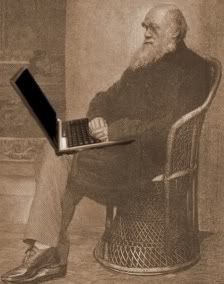
The great English naturalist Charles Darwin (1809-1882) revolutionized our understanding of life on earth. This site is the largest collection of his work ever assembled.
10/13/06
The definition of the human network.
The internet is about the people. Just as routers talk to routers.
Humans like to connect with other humans. It is part of our desire to receive and transmit data, much like a router. We switch between relationships, sometimes one to many. The most powerful relationships are p2p. Person to person, that is. Husband and wife, father and son, brother and sister. Or just college pals. The networking, starts within us. We all are nodes on a human network.
-Om Malik
Humans like to connect with other humans. It is part of our desire to receive and transmit data, much like a router. We switch between relationships, sometimes one to many. The most powerful relationships are p2p. Person to person, that is. Husband and wife, father and son, brother and sister. Or just college pals. The networking, starts within us. We all are nodes on a human network.
-Om Malik
10/10/06
Look ma, no hands.
The first teenager to play a two-dimensional video game, Space Invaders, using only the signals from his brain to make movements. Sweet.
10/4/06

Subscribe to:
Posts (Atom)