
Showing posts with label refreshing. Show all posts
Showing posts with label refreshing. Show all posts
11/4/08


7/24/08
7/23/08
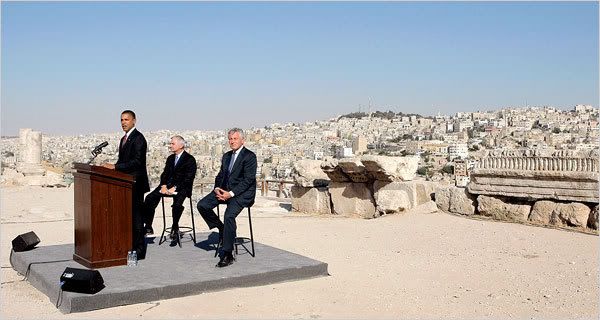
In Jordan
I know he's not the President yet, but he's playing the part very well. Refreshing. Looks like the price of oil is lowering a bit. I don't think it's a coincidence.

7/15/08
6/16/08
2/22/08
Thanks Becca, for this:
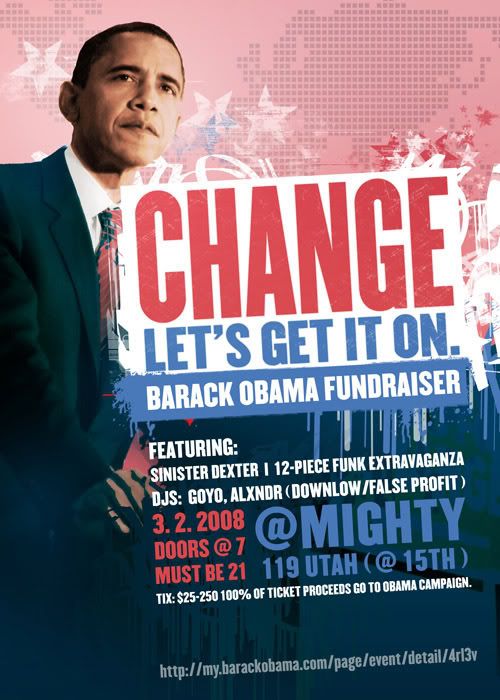
Come out Sunday, March 2nd, as we march forth to March 4th. One million strong.
It's a Barack Obama Fundraiser at Mighty...
With:
Sinister Dexter, a 12-piece funk extravaganza
DJs Alxndr (DownLow/False Profit)
and Goyo
Special guest author Ayelet Waldman ("Daughter's Keeper" and "Love and Other Impossible Pursuits" - wife of Michael Chabon - classmate of Barack's at Harvard Law School) will make a guest appearance.
Woop woop!
Doors at 7pm.
You must be 21.
Ticket donation is
a minimum of $25/person.
Please give as much as you're able to (federal limit is $2,300). 100% of your donation will go to the Obama campaign. Give what you feel is the right investment in the future of our country. And, even if you can't come, feel free to pass it on and make a gift to the campaign anyway!
**You MUST RSVP for the event here:** http://my.barackobama.com/page/event/detail/4rl3v
Two days after we party at Mighty, Texas and Ohio will be voting in a crucial primary that will help decide the fate of this election.
It's a historic time. It's a time when nearly one million people have already dug into their pockets to invest in their future -- to invest in a candidate who does not accept money from political action committees or lobbyists. A candidate who inspires hope. Let's help the campaign reach the milestone of one million donors by March 4th. The time is now.
Yes. We. Can! Are you fired up?!?
We'll see you there! Pass it on!
Yoav S., Shira Kates, Maya Baratz, Steve Sommers, Freida Ravasco, Amy Lit
2/11/08
Everyone should read this
Some have said that Barack Obama's opposition to America initiating the Iraq war is a "fairytale" and that his position on the war has been "inconsistent." But on October 2, 2002 at the Federal Plaza in Chicago Senator Barack Obama, then an Illinois state senator, delivered these remarks:
"I stand before you as someone who is not opposed to war in all circumstances. The Civil War was one of the bloodiest in history, and yet it was only through the crucible of the sword, the sacrifice of multitudes, that we could begin to perfect this union and drive the scourge of slavery from our soil.
I Don't Oppose All Wars
I don't oppose all wars. My grandfather signed up for a war the day after Pearl Harbor was bombed, fought in Patton's army. He fought in the name of a larger freedom, part of that arsenal of democracy that triumphed over evil. I don't oppose all wars. After September 11, after witnessing the carnage and destruction, the dust and the tears, I supported this administration's pledge to hunt down and root out those who would slaughter innocents in the name of intolerance, and I would willingly take up arms myself to prevent such tragedy from happening again.
Opposed to Dumb, Rash Wars
I don't oppose all wars. What I am opposed to is a dumb war. What I am opposed to is a rash war. What I am opposed to is the cynical attempt by Richard Perle and Paul Wolfowitz and other armchair, weekend warriors in this administration to shove their own ideological agendas down our throats, irrespective of the costs in lives lost and in hardships borne. What I am opposed to is the attempt by political hacks like Karl Rove to distract us from a rise in the uninsured, a rise in the poverty rate, a drop in the median income, to distract us from corporate scandals and a stock market that has just gone through the worst month since the Great Depression. That's what I'm opposed to. A dumb war. A rash war. A war based not on reason but on passion, not on principle but on politics.
On Saddam Hussein
Now let me be clear: I suffer no illusions about Saddam Hussein. He is a brutal man. A ruthless man. A man who butchers his own people to secure his own power.... The world, and the Iraqi people, would be better off without him. But I also know that Saddam poses no imminent and direct threat to the United States, or to his neighbors...and that in concert with the international community he can be contained until, in the way of all petty dictators, he falls away into the dustbin of history. I know that even a successful war against Iraq will require a U.S. occupation of undetermined length, at undetermined cost, with undetermined consequences. I know that an invasion of Iraq without a clear rationale and without strong international support will only fan the flames of the Middle East, and encourage the worst, rather than best, impulses of the Arab world, and strengthen the recruitment arm of al-Qaeda. I am not opposed to all wars. I'm opposed to dumb wars. So for those of us who seek a more just and secure world for our children, let us send a clear message to the president.
You Want a Fight, President Bush?
You want a fight, President Bush? Let's finish the fight with Bin Laden and al-Qaeda, through effective, coordinated intelligence, and a shutting down of the financial networks that support terrorism, and a homeland security program that involves more than color-coded warnings.
You want a fight, President Bush? Let's fight to make sure that...we vigorously enforce a nonproliferation treaty, and that former enemies and current allies like Russia safeguard and ultimately eliminate their stores of nuclear material, and that nations like Pakistan and India never use the terrible weapons already in their possession, and that the arms merchants in our own country stop feeding the countless wars that rage across the globe.
You want a fight, President Bush? Let's fight to make sure our so-called allies in the Middle East, the Saudis and the Egyptians, stop oppressing their own people, and suppressing dissent, and tolerating corruption and inequality, and mismanaging their economies so that their youth grow up without education, without prospects, without hope, the ready recruits of terrorist cells.
You want a fight, President Bush? Let's fight to wean ourselves off Middle East oil through an energy policy that doesn't simply serve the interests of Exxon and Mobil. Those are the battles that we need to fight. Those are the battles that we willingly join. The battles against ignorance and intolerance. Corruption and greed. Poverty and despair.
The consequences of war are dire, the sacrifices immeasurable. We may have occasion in our lifetime to once again rise up in defense of our freedom, and pay the wages of war. But we ought not – we will not – travel down that hellish path blindly. Nor should we allow those who would march off and pay the ultimate sacrifice, who would prove the full measure of devotion with their blood, to make such an awful sacrifice in vain."
Barack Obama delivered his powerful speech at the Federal Plaza in Chicago October 2, 2002
10/26/07
Oversight
Waxman has become the Bush administration's worst nightmare: a Democrat in the majority with subpoena power and the inclination to overturn rocks. But in Waxman the White House also faces an indefatigable capital veteran -- with a staff renowned for its depth and experience -- who has been waiting for this for 14 years.
article
article
5/22/07
Free To Be Al Gore
By E. J. Dionne Jr.
Tuesday, May 22, 2007
Boy, it would be fun if Al Gore changed his mind and ran for president -- fun for the voters, anyway. Imagine a candidate whose preelection book is devoted in large part to an attack on the media for waging war on reason.
Politicians, it is often said, never win by attacking the media. That's simply not true. Conservatives have been attacking the media for decades, to good effect from their point of view. Their intimidation sometimes worked -- go back to the coverage of the 2000 Florida recount if you want to see media bias. When intimidation fails, they declare inconvenient facts to be merely "liberal" opinions.
It's delightful to see the critique coming from the other side. Gore's book, "The Assault on Reason," to be released today, is about "the strangeness of our public discourse" as mediated through television. He thinks the Internet may revive the art of reasoned argument that has been lost in our obsessions with "Britney and KFed, and Lindsay and Paris and Nicole."
It's entertaining to talk to Gore these days because he's so clearly enjoying himself. (That's probably why he won't run for president.) During a 40-minute telephone interview yesterday, he did not speak as if there were focus-grouped sentences dancing around in his head. Nor did he worry about saying things that some consultant would fret about for weeks afterward.
For example, when Gore is asked if any of the Democrats running for president were changing the system he holds in such low esteem, he pulls no punches. "They're good people trapped in a bad system," he says, "and I think it's the system that needs to be changed and I don't see them changing it." The campaign dialogue so far, he says, has not been "very enriching or illuminating" in "either party." But, no, that doesn't mean he's going to run, though he never completely shuts the door. It's part of the fun he's having.
He ascribes the failure to have a full-throated debate on Iraq back in 2002 -- when he spoke out against the looming war, to much nasty jeering from the right -- to the administration's decision to politicize the issue before the midterm elections, but also to "meekness" and "timidity" in both "the legislative branch of government" and in "the press corps."
"A lot of people were afraid of being accused of being unpatriotic," he says. "One of the symptoms of this problem -- the diminishing role for reason, fact and logic -- is that what rushes in to fill the vacuum are extreme partisanship, ideology, fundamentalism and extreme nationalism."
If the Bush administration came to mind as you read those words, Gore wouldn't object. Historians who need a catalogue of what went wrong after, oh, Dec. 12, 2000, the day of a certain U.S. Supreme Court decision, will find it all in his book.
Gore, so gracious after that unfortunate court ruling, lets it rip against Bush on Iraq, civil liberties, global warming and much else. Gore writes of "something deeply troubling about President Bush's relationship to reason, his disdain for facts, and his lack of curiosity. . . ."
That sentiment will speak to the multitudes disgusted with the Bush presidency -- and draw vituperation from the same people who accused Gore of trying to "steal" the 2000 election simply because he wanted Florida's votes recounted.
Seven years later, the mood is quite different, partly because of the rise of a new Internet political community that Gore wants to protect from the designs of big companies. Say what you will, the blogs and other online gathering places do promote a culture of engagement rather than passivity. The raucous back-and-forth they encourage looks, at least sometimes, like real, live democratic politics.
But the larger change is that the very process Gore describes -- of propaganda taken as fact, of slogans taken as arguments, of repetition substituting for logic and, yes, of lies and half-truths taken as truth -- is now well-recognized. What worked against Gore during the recount and what worked for the administration in the run-up to the Iraq war doesn't work anymore. That is an advance for democracy and for reason.
Gore, to his credit, won't talk about Florida, but I will. Whatever flaws he has, Gore suffered through an extreme injustice with great dignity. His revenge is to have been right about a lot of things: right about the power of the Internet, right about global warming and right about Iraq.
By E. J. Dionne Jr.
Tuesday, May 22, 2007; A15
Tuesday, May 22, 2007
Boy, it would be fun if Al Gore changed his mind and ran for president -- fun for the voters, anyway. Imagine a candidate whose preelection book is devoted in large part to an attack on the media for waging war on reason.
Politicians, it is often said, never win by attacking the media. That's simply not true. Conservatives have been attacking the media for decades, to good effect from their point of view. Their intimidation sometimes worked -- go back to the coverage of the 2000 Florida recount if you want to see media bias. When intimidation fails, they declare inconvenient facts to be merely "liberal" opinions.
It's delightful to see the critique coming from the other side. Gore's book, "The Assault on Reason," to be released today, is about "the strangeness of our public discourse" as mediated through television. He thinks the Internet may revive the art of reasoned argument that has been lost in our obsessions with "Britney and KFed, and Lindsay and Paris and Nicole."
It's entertaining to talk to Gore these days because he's so clearly enjoying himself. (That's probably why he won't run for president.) During a 40-minute telephone interview yesterday, he did not speak as if there were focus-grouped sentences dancing around in his head. Nor did he worry about saying things that some consultant would fret about for weeks afterward.
For example, when Gore is asked if any of the Democrats running for president were changing the system he holds in such low esteem, he pulls no punches. "They're good people trapped in a bad system," he says, "and I think it's the system that needs to be changed and I don't see them changing it." The campaign dialogue so far, he says, has not been "very enriching or illuminating" in "either party." But, no, that doesn't mean he's going to run, though he never completely shuts the door. It's part of the fun he's having.
He ascribes the failure to have a full-throated debate on Iraq back in 2002 -- when he spoke out against the looming war, to much nasty jeering from the right -- to the administration's decision to politicize the issue before the midterm elections, but also to "meekness" and "timidity" in both "the legislative branch of government" and in "the press corps."
"A lot of people were afraid of being accused of being unpatriotic," he says. "One of the symptoms of this problem -- the diminishing role for reason, fact and logic -- is that what rushes in to fill the vacuum are extreme partisanship, ideology, fundamentalism and extreme nationalism."
If the Bush administration came to mind as you read those words, Gore wouldn't object. Historians who need a catalogue of what went wrong after, oh, Dec. 12, 2000, the day of a certain U.S. Supreme Court decision, will find it all in his book.
Gore, so gracious after that unfortunate court ruling, lets it rip against Bush on Iraq, civil liberties, global warming and much else. Gore writes of "something deeply troubling about President Bush's relationship to reason, his disdain for facts, and his lack of curiosity. . . ."
That sentiment will speak to the multitudes disgusted with the Bush presidency -- and draw vituperation from the same people who accused Gore of trying to "steal" the 2000 election simply because he wanted Florida's votes recounted.
Seven years later, the mood is quite different, partly because of the rise of a new Internet political community that Gore wants to protect from the designs of big companies. Say what you will, the blogs and other online gathering places do promote a culture of engagement rather than passivity. The raucous back-and-forth they encourage looks, at least sometimes, like real, live democratic politics.
But the larger change is that the very process Gore describes -- of propaganda taken as fact, of slogans taken as arguments, of repetition substituting for logic and, yes, of lies and half-truths taken as truth -- is now well-recognized. What worked against Gore during the recount and what worked for the administration in the run-up to the Iraq war doesn't work anymore. That is an advance for democracy and for reason.
Gore, to his credit, won't talk about Florida, but I will. Whatever flaws he has, Gore suffered through an extreme injustice with great dignity. His revenge is to have been right about a lot of things: right about the power of the Internet, right about global warming and right about Iraq.
By E. J. Dionne Jr.
Tuesday, May 22, 2007; A15
5/3/07
The Obama campaign posted this today:
Chairman Howard Dean
Democratic National Committee
430 S. Capitol St., SE
Washington, DC 20003
Dear Chairman Dean:
I am writing in strong support of a letter from a bipartisan coalition of academics, bloggers and Internet activists recently addressed to you and the Democratic National Committee. The letter asks that the video from any Democratic Presidential debate be available freely after the debate, by either placing the video in the public domain, or licensing it under a Creative Commons (Attribution) license.
As you know, the Internet has enabled an extraordinary range of citizens to participate in the political dialogue around this election. Much of that participation will take the form of citizen generated content. We, as a Party, should do everything that we can to encourage this participation. Not only will it keep us focused on the issues that matter most to America, it will also encourage participation by a wide range of our youth who have traditionally simply tuned out from politics.
The letter does not propose some radical change in copyright law, or an unjustified expansion in “fair use.” Instead, it simply asks that any purported copyright owner of video from the debates waive that copyright.
I am a strong believer in the importance of copyright, especially in a digital age. But there is no reason that this particular class of content needs the protection. We have incentive enough to debate. The networks have incentive enough to broadcast those debates. Rather than restricting the product of those debates, we should instead make sure that our democracy and citizens have the chance to benefit from them in all the ways that technology makes possible.
Your presidential campaign used the Internet to break new ground in citizen political participation. I would urge you to take the lead again by continuing to support this important medium of political speech. And I offer whatever help I can to secure the support of others as well.
Sincerely,
Barack Obama
Democratic National Committee
430 S. Capitol St., SE
Washington, DC 20003
Dear Chairman Dean:
I am writing in strong support of a letter from a bipartisan coalition of academics, bloggers and Internet activists recently addressed to you and the Democratic National Committee. The letter asks that the video from any Democratic Presidential debate be available freely after the debate, by either placing the video in the public domain, or licensing it under a Creative Commons (Attribution) license.
As you know, the Internet has enabled an extraordinary range of citizens to participate in the political dialogue around this election. Much of that participation will take the form of citizen generated content. We, as a Party, should do everything that we can to encourage this participation. Not only will it keep us focused on the issues that matter most to America, it will also encourage participation by a wide range of our youth who have traditionally simply tuned out from politics.
The letter does not propose some radical change in copyright law, or an unjustified expansion in “fair use.” Instead, it simply asks that any purported copyright owner of video from the debates waive that copyright.
I am a strong believer in the importance of copyright, especially in a digital age. But there is no reason that this particular class of content needs the protection. We have incentive enough to debate. The networks have incentive enough to broadcast those debates. Rather than restricting the product of those debates, we should instead make sure that our democracy and citizens have the chance to benefit from them in all the ways that technology makes possible.
Your presidential campaign used the Internet to break new ground in citizen political participation. I would urge you to take the lead again by continuing to support this important medium of political speech. And I offer whatever help I can to secure the support of others as well.
Sincerely,
Barack Obama
4/29/07
4/5/07
Good news
The united States is being represented on the world stage by someone who speaks intelligently. Nancy Pelosi went to Saudi Arabia to, get this, talk. What a weakling. Having a conversation with another country? Gasp! What is she thinking? Opening dialogue? Just plain wreckless if you ask me.
Pelosi visits Saudi Arabia
By DONNA ABU-NASR Associated Press Writer
© 2007 The Associated Press
RIYADH, Saudi Arabia — U.S. House Speaker Nancy Pelosi visited Saudi Arabia's unelected advisory council Thursday, the closest thing in the kingdom to a legislature, where she tried out her counterpart's chair — a privilege no Saudi woman can have because women cannot become legislators.
Pelosi, the first woman speaker of the House, said she raised the issue of Saudi Arabia's lack of female politicians with Saudi government officials on the last stop of her Mideast tour, but she refrained from criticizing the kingdom over it.
"It's a nice view from here," Pelosi said as she sat in the chair, facing the ornate chamber with its deep blue and yellow chairs and gilded ironwork. "This chair is very comfortable."
U.S. Rep. Tom Lantos, the head of the House Foreign Affairs Committee who was traveling with Pelosi, looked at the gavel in front of her and quipped: "It's a small gavel, Madame Speaker. You may want to wield it."
Pelosi later sidestepped a question on how she felt about the absence of female Saudi council members, saying: "I am very pleased that after 200-plus years in the U.S. we finally have a speaker. It took us a long time."
Asked if she raised the issue at Thursday's meeting with the council members, she said: "The issue has been brought up in our discussions with the Saudis on this trip."
The Majlis al-Shura, or Consultative Council, was expanded and given more powers in 1992 as a gesture toward forming a legislature. Its 150 members are chosen by the king and advise him, and the body has the power to propose new laws for the government's approval.
Saudi King Abdullah has spoken of reform in this key U.S. ally, but change has been slow and limited. The kingdom, ruled by the strict Wahhabi interpretation of Islam, held its first elections in 2005, choosing local councils. Women were barred from voting or running.
Pelosi arrived in Saudi Arabia on Wednesday, meeting with Abdullah at his farm outside Riyadh.
Earlier Wednesday, she met in Damascus with Syrian President Bashar Assad, bringing a sharp rebuke from the White House. The Bush administration said the visit undermined its policy of isolating Syria, which it accuses of supporting terrorism.
Pelosi and her delegation — which included a House Republican — aimed to challenge the policy, arguing that talking with Damascus is the only way to push it to change its ways. Another Republican congressman, Darrell Issa, met with Assad on Thursday, the latest in a string of lawmakers from both parties who have made the trip in recent months.
The Pelosi visit brought no immediate change in Syria's positions. Pelosi told reporters afterward she gave Assad a message from Israeli Prime Minister Ehud Olmert that Israel was ready for peace talks with Syria, and that Assad told her Syria was also willing to hold negotiations.
Olmert's office quickly issued a statement making clear there was no new peace initiative, underlining Israel's stance that Syria must first stop support for the militant groups Hamas and Hezbollah.
"Despite Israel's desire for peace with Syria, Syria continues to be part of the axis of evil and an element that encourages terror in the entire Middle East," the statement said. "In order to conduct real peace negotiations, Syria must cease its support for terror."
Assad has repeatedly said he wants peace talks with Israel, seeking a return of the Golan Heights occupied by Israel in the 1967 Mideast war. But efforts to bring new talks have not gotten off the ground because of the issue of Damascus' support for the militants.
Washington accuses Syria of backing Hamas and Hezbollah, two groups it deems terrorist organizations, and fueling Iraq's violence by allowing Sunni insurgents to operate from its territory.
In Saudi Arabia, Pelosi and King Abdullah discussed at length the Arab peace initiative, which was proposed by Saudi Arabia in 2002 and was relaunched at a summit in Riyadh last week.
The initiative offers Israel peace with all Arab states if it withdraws from lands seized in 1967 and allows the creation of a Palestinian state with its capital in east Jerusalem. Israel has said it would only accept the proposal if some changes were made — particularly over the issue of refugees — but Arab nations have said Israel should accept it as a basis for negotiations.
"I explained to him that this can be a very important and historic proposal if he is prepared for a discussion and a dialogue and not a presentation on a take-it-or-leave-it basis," Lantos told the Associated Press. "His reaction was very positive."
Lantos also said he brought up his legislation to create an international nuclear fuel bank that would make it unnecessary for any nation, including Iran, to develop uranium enrichment because nuclear fuel would be available.
Concerned by Iran's program, Saudi Arabia and Gulf states have expressed an interest in developing nuclear energy programs.
Pelosi was welcomed at the Shura council by its head, Sheik Saleh bin Humaid, who is also the imam of the Grand Mosque in Mecca. He placed his right hand on his chest in a traditional Arab greeting, since conservative Islamic clerics don't shake hands with women, and she returned the greeting in a similar manner.
During her meetings, Pelosi did not wear the long black robe, or abaya, and headscarf that Saudi and non-Saudi women have to wear in the kingdom. Visiting female dignitaries are not expected to wear it.
Ihsan Abu-Holeiqa, a member of the council, said the meeting with Pelosi included discussion of the difficulties Saudis have in getting U.S. visas since the Sept. 11 attacks — which were carried out by 19 hijackers, 15 of them Saudis.
"We told her there should be some movement on the visa issue because, while we understand the security needs, the situation is unacceptable," said Abu-Holeiqa.
Pelosi leaves Saudi Arabia for Washington early Friday.
Pelosi visits Saudi Arabia
By DONNA ABU-NASR Associated Press Writer
© 2007 The Associated Press
RIYADH, Saudi Arabia — U.S. House Speaker Nancy Pelosi visited Saudi Arabia's unelected advisory council Thursday, the closest thing in the kingdom to a legislature, where she tried out her counterpart's chair — a privilege no Saudi woman can have because women cannot become legislators.
Pelosi, the first woman speaker of the House, said she raised the issue of Saudi Arabia's lack of female politicians with Saudi government officials on the last stop of her Mideast tour, but she refrained from criticizing the kingdom over it.
"It's a nice view from here," Pelosi said as she sat in the chair, facing the ornate chamber with its deep blue and yellow chairs and gilded ironwork. "This chair is very comfortable."
U.S. Rep. Tom Lantos, the head of the House Foreign Affairs Committee who was traveling with Pelosi, looked at the gavel in front of her and quipped: "It's a small gavel, Madame Speaker. You may want to wield it."
Pelosi later sidestepped a question on how she felt about the absence of female Saudi council members, saying: "I am very pleased that after 200-plus years in the U.S. we finally have a speaker. It took us a long time."
Asked if she raised the issue at Thursday's meeting with the council members, she said: "The issue has been brought up in our discussions with the Saudis on this trip."
The Majlis al-Shura, or Consultative Council, was expanded and given more powers in 1992 as a gesture toward forming a legislature. Its 150 members are chosen by the king and advise him, and the body has the power to propose new laws for the government's approval.
Saudi King Abdullah has spoken of reform in this key U.S. ally, but change has been slow and limited. The kingdom, ruled by the strict Wahhabi interpretation of Islam, held its first elections in 2005, choosing local councils. Women were barred from voting or running.
Pelosi arrived in Saudi Arabia on Wednesday, meeting with Abdullah at his farm outside Riyadh.
Earlier Wednesday, she met in Damascus with Syrian President Bashar Assad, bringing a sharp rebuke from the White House. The Bush administration said the visit undermined its policy of isolating Syria, which it accuses of supporting terrorism.
Pelosi and her delegation — which included a House Republican — aimed to challenge the policy, arguing that talking with Damascus is the only way to push it to change its ways. Another Republican congressman, Darrell Issa, met with Assad on Thursday, the latest in a string of lawmakers from both parties who have made the trip in recent months.
The Pelosi visit brought no immediate change in Syria's positions. Pelosi told reporters afterward she gave Assad a message from Israeli Prime Minister Ehud Olmert that Israel was ready for peace talks with Syria, and that Assad told her Syria was also willing to hold negotiations.
Olmert's office quickly issued a statement making clear there was no new peace initiative, underlining Israel's stance that Syria must first stop support for the militant groups Hamas and Hezbollah.
"Despite Israel's desire for peace with Syria, Syria continues to be part of the axis of evil and an element that encourages terror in the entire Middle East," the statement said. "In order to conduct real peace negotiations, Syria must cease its support for terror."
Assad has repeatedly said he wants peace talks with Israel, seeking a return of the Golan Heights occupied by Israel in the 1967 Mideast war. But efforts to bring new talks have not gotten off the ground because of the issue of Damascus' support for the militants.
Washington accuses Syria of backing Hamas and Hezbollah, two groups it deems terrorist organizations, and fueling Iraq's violence by allowing Sunni insurgents to operate from its territory.
In Saudi Arabia, Pelosi and King Abdullah discussed at length the Arab peace initiative, which was proposed by Saudi Arabia in 2002 and was relaunched at a summit in Riyadh last week.
The initiative offers Israel peace with all Arab states if it withdraws from lands seized in 1967 and allows the creation of a Palestinian state with its capital in east Jerusalem. Israel has said it would only accept the proposal if some changes were made — particularly over the issue of refugees — but Arab nations have said Israel should accept it as a basis for negotiations.
"I explained to him that this can be a very important and historic proposal if he is prepared for a discussion and a dialogue and not a presentation on a take-it-or-leave-it basis," Lantos told the Associated Press. "His reaction was very positive."
Lantos also said he brought up his legislation to create an international nuclear fuel bank that would make it unnecessary for any nation, including Iran, to develop uranium enrichment because nuclear fuel would be available.
Concerned by Iran's program, Saudi Arabia and Gulf states have expressed an interest in developing nuclear energy programs.
Pelosi was welcomed at the Shura council by its head, Sheik Saleh bin Humaid, who is also the imam of the Grand Mosque in Mecca. He placed his right hand on his chest in a traditional Arab greeting, since conservative Islamic clerics don't shake hands with women, and she returned the greeting in a similar manner.
During her meetings, Pelosi did not wear the long black robe, or abaya, and headscarf that Saudi and non-Saudi women have to wear in the kingdom. Visiting female dignitaries are not expected to wear it.
Ihsan Abu-Holeiqa, a member of the council, said the meeting with Pelosi included discussion of the difficulties Saudis have in getting U.S. visas since the Sept. 11 attacks — which were carried out by 19 hijackers, 15 of them Saudis.
"We told her there should be some movement on the visa issue because, while we understand the security needs, the situation is unacceptable," said Abu-Holeiqa.
Pelosi leaves Saudi Arabia for Washington early Friday.
1/30/07
1/23/07
Tuesday, January 23, 2007
Democratic Response of Senator Jim Webb
To the President's State of the Union Address
Good evening.
I'm Senator Jim Webb, from Virginia, where this year we will celebrate the 400th anniversary of the settlement of Jamestown - an event that marked the first step in the long journey that has made us the greatest and most prosperous nation on earth.
It would not be possible in this short amount of time to actually rebut the President's message, nor would it be useful. Let me simply say that we in the Democratic Party hope that this administration is serious about improving education and healthcare for all Americans, and addressing such domestic priorities as restoring the vitality of New Orleans.
Further, this is the seventh time the President has mentioned energy independence in his state of the union message, but for the first time this exchange is taking place in a Congress led by the Democratic Party. We are looking for affirmative solutions that will strengthen our nation by freeing us from our dependence on foreign oil, and spurring a wave of entrepreneurial growth in the form of alternate energy programs. We look forward to working with the President and his party to bring about these changes.
There are two areas where our respective parties have largely stood in contradiction, and I want to take a few minutes to address them tonight. The first relates to how we see the health of our economy - how we measure it, and how we ensure that its benefits are properly shared among all Americans. The second regards our foreign policy - how we might bring the war in Iraq to a proper conclusion that will also allow us to continue to fight the war against international terrorism, and to address other strategic concerns that our country faces around the world.
When one looks at the health of our economy, it's almost as if we are living in two different countries. Some say that things have never been better. The stock market is at an all-time high, and so are corporate profits. But these benefits are not being fairly shared. When I graduated from college, the average corporate CEO made 20 times what the average worker did; today, it's nearly 400 times. In other words, it takes the average worker more than a year to make the money that his or her boss makes in one day.
Wages and salaries for our workers are at all-time lows as a percentage of national wealth, even though the productivity of American workers is the highest in the world. Medical costs have skyrocketed. College tuition rates are off the charts. Our manufacturing base is being dismantled and sent overseas. Good American jobs are being sent along with them.
In short, the middle class of this country, our historic backbone and our best hope for a strong society in the future, is losing its place at the table. Our workers know this, through painful experience. Our white-collar professionals are beginning to understand it, as their jobs start disappearing also. And they expect, rightly, that in this age of globalization, their government has a duty to insist that their concerns be dealt with fairly in the international marketplace.
In the early days of our republic, President Andrew Jackson established an important principle of American-style democracy - that we should measure the health of our society not at its apex, but at its base. Not with the numbers that come out of Wall Street, but with the living conditions that exist on Main Street. We must recapture that spirit today.
And under the leadership of the new Democratic Congress, we are on our way to doing so. The House just passed a minimum wage increase, the first in ten years, and the Senate will soon follow. We've introduced a broad legislative package designed to regain the trust of the American people. We've established a tone of cooperation and consensus that extends beyond party lines. We're working to get the right things done, for the right people and for the right reasons.
With respect to foreign policy, this country has patiently endured a mismanaged war for nearly four years. Many, including myself, warned even before the war began that it was unnecessary, that it would take our energy and attention away from the larger war against terrorism, and that invading and occupying Iraq would leave us strategically vulnerable in the most violent and turbulent corner of the world.
I want to share with all of you a picture that I have carried with me for more than 50 years. This is my father, when he was a young Air Force captain, flying cargo planes during the Berlin Airlift. He sent us the picture from Germany, as we waited for him, back here at home. When I was a small boy, I used to take the picture to bed with me every night, because for more than three years my father was deployed, unable to live with us full-time, serving overseas or in bases where there was no family housing. I still keep it, to remind me of the sacrifices that my mother and others had to make, over and over again, as my father gladly served our country. I was proud to follow in his footsteps, serving as a Marine in Vietnam. My brother did as well, serving as a Marine helicopter pilot. My son has joined the tradition, now serving as an infantry Marine in Iraq.
Like so many other Americans, today and throughout our history, we serve and have served, not for political reasons, but because we love our country. On the political issues - those matters of war and peace, and in some cases of life and death - we trusted the judgment of our national leaders. We hoped that they would be right, that they would measure with accuracy the value of our lives against the enormity of the national interest that might call upon us to go into harm's way.
We owed them our loyalty, as Americans, and we gave it. But they owed us - sound judgment, clear thinking, concern for our welfare, a guarantee that the threat to our country was equal to the price we might be called upon to pay in defending it.
The President took us into this war recklessly. He disregarded warnings from the national security adviser during the first Gulf War, the chief of staff of the army, two former commanding generals of the Central Command, whose jurisdiction includes Iraq, the director of operations on the Joint Chiefs of Staff, and many, many others with great integrity and long experience in national security affairs. We are now, as a nation, held hostage to the predictable - and predicted - disarray that has followed.
The war's costs to our nation have been staggering. Financially. The damage to our reputation around the world. The lost opportunities to defeat the forces of international terrorism. And especially the precious blood of our citizens who have stepped forward to serve.
The majority of the nation no longer supports the way this war is being fought; nor does the majority of our military. We need a new direction. Not one step back from the war against international terrorism. Not a precipitous withdrawal that ignores the possibility of further chaos. But an immediate shift toward strong regionally-based diplomacy, a policy that takes our soldiers off the streets of Iraq's cities, and a formula that will in short order allow our combat forces to leave Iraq.
On both of these vital issues, our economy and our national security, it falls upon those of us in elected office to take action.
Regarding the economic imbalance in our country, I am reminded of the situation President Theodore Roosevelt faced in the early days of the 20th century. America was then, as now, drifting apart along class lines. The so-called robber barons were unapologetically raking in a huge percentage of the national wealth. The dispossessed workers at the bottom were threatening revolt.
Roosevelt spoke strongly against these divisions. He told his fellow Republicans that they must set themselves "as resolutely against improper corporate influence on the one hand as against demagogy and mob rule on the other." And he did something about it.
As I look at Iraq, I recall the words of former general and soon-to-be President Dwight Eisenhower during the dark days of the Korean War, which had fallen into a bloody stalemate. "When comes the end?" asked the General who had commanded our forces in Europe during World War Two. And as soon as he became President, he brought the Korean War to an end.
These Presidents took the right kind of action, for the benefit of the American people and for the health of our relations around the world. Tonight we are calling on this President to take similar action, in both areas. If he does, we will join him. If he does not, we will be showing him the way.
Thank you for listening. And God bless America.
To the President's State of the Union Address
Good evening.
I'm Senator Jim Webb, from Virginia, where this year we will celebrate the 400th anniversary of the settlement of Jamestown - an event that marked the first step in the long journey that has made us the greatest and most prosperous nation on earth.
It would not be possible in this short amount of time to actually rebut the President's message, nor would it be useful. Let me simply say that we in the Democratic Party hope that this administration is serious about improving education and healthcare for all Americans, and addressing such domestic priorities as restoring the vitality of New Orleans.
Further, this is the seventh time the President has mentioned energy independence in his state of the union message, but for the first time this exchange is taking place in a Congress led by the Democratic Party. We are looking for affirmative solutions that will strengthen our nation by freeing us from our dependence on foreign oil, and spurring a wave of entrepreneurial growth in the form of alternate energy programs. We look forward to working with the President and his party to bring about these changes.
There are two areas where our respective parties have largely stood in contradiction, and I want to take a few minutes to address them tonight. The first relates to how we see the health of our economy - how we measure it, and how we ensure that its benefits are properly shared among all Americans. The second regards our foreign policy - how we might bring the war in Iraq to a proper conclusion that will also allow us to continue to fight the war against international terrorism, and to address other strategic concerns that our country faces around the world.
When one looks at the health of our economy, it's almost as if we are living in two different countries. Some say that things have never been better. The stock market is at an all-time high, and so are corporate profits. But these benefits are not being fairly shared. When I graduated from college, the average corporate CEO made 20 times what the average worker did; today, it's nearly 400 times. In other words, it takes the average worker more than a year to make the money that his or her boss makes in one day.
Wages and salaries for our workers are at all-time lows as a percentage of national wealth, even though the productivity of American workers is the highest in the world. Medical costs have skyrocketed. College tuition rates are off the charts. Our manufacturing base is being dismantled and sent overseas. Good American jobs are being sent along with them.
In short, the middle class of this country, our historic backbone and our best hope for a strong society in the future, is losing its place at the table. Our workers know this, through painful experience. Our white-collar professionals are beginning to understand it, as their jobs start disappearing also. And they expect, rightly, that in this age of globalization, their government has a duty to insist that their concerns be dealt with fairly in the international marketplace.
In the early days of our republic, President Andrew Jackson established an important principle of American-style democracy - that we should measure the health of our society not at its apex, but at its base. Not with the numbers that come out of Wall Street, but with the living conditions that exist on Main Street. We must recapture that spirit today.
And under the leadership of the new Democratic Congress, we are on our way to doing so. The House just passed a minimum wage increase, the first in ten years, and the Senate will soon follow. We've introduced a broad legislative package designed to regain the trust of the American people. We've established a tone of cooperation and consensus that extends beyond party lines. We're working to get the right things done, for the right people and for the right reasons.
With respect to foreign policy, this country has patiently endured a mismanaged war for nearly four years. Many, including myself, warned even before the war began that it was unnecessary, that it would take our energy and attention away from the larger war against terrorism, and that invading and occupying Iraq would leave us strategically vulnerable in the most violent and turbulent corner of the world.
I want to share with all of you a picture that I have carried with me for more than 50 years. This is my father, when he was a young Air Force captain, flying cargo planes during the Berlin Airlift. He sent us the picture from Germany, as we waited for him, back here at home. When I was a small boy, I used to take the picture to bed with me every night, because for more than three years my father was deployed, unable to live with us full-time, serving overseas or in bases where there was no family housing. I still keep it, to remind me of the sacrifices that my mother and others had to make, over and over again, as my father gladly served our country. I was proud to follow in his footsteps, serving as a Marine in Vietnam. My brother did as well, serving as a Marine helicopter pilot. My son has joined the tradition, now serving as an infantry Marine in Iraq.
Like so many other Americans, today and throughout our history, we serve and have served, not for political reasons, but because we love our country. On the political issues - those matters of war and peace, and in some cases of life and death - we trusted the judgment of our national leaders. We hoped that they would be right, that they would measure with accuracy the value of our lives against the enormity of the national interest that might call upon us to go into harm's way.
We owed them our loyalty, as Americans, and we gave it. But they owed us - sound judgment, clear thinking, concern for our welfare, a guarantee that the threat to our country was equal to the price we might be called upon to pay in defending it.
The President took us into this war recklessly. He disregarded warnings from the national security adviser during the first Gulf War, the chief of staff of the army, two former commanding generals of the Central Command, whose jurisdiction includes Iraq, the director of operations on the Joint Chiefs of Staff, and many, many others with great integrity and long experience in national security affairs. We are now, as a nation, held hostage to the predictable - and predicted - disarray that has followed.
The war's costs to our nation have been staggering. Financially. The damage to our reputation around the world. The lost opportunities to defeat the forces of international terrorism. And especially the precious blood of our citizens who have stepped forward to serve.
The majority of the nation no longer supports the way this war is being fought; nor does the majority of our military. We need a new direction. Not one step back from the war against international terrorism. Not a precipitous withdrawal that ignores the possibility of further chaos. But an immediate shift toward strong regionally-based diplomacy, a policy that takes our soldiers off the streets of Iraq's cities, and a formula that will in short order allow our combat forces to leave Iraq.
On both of these vital issues, our economy and our national security, it falls upon those of us in elected office to take action.
Regarding the economic imbalance in our country, I am reminded of the situation President Theodore Roosevelt faced in the early days of the 20th century. America was then, as now, drifting apart along class lines. The so-called robber barons were unapologetically raking in a huge percentage of the national wealth. The dispossessed workers at the bottom were threatening revolt.
Roosevelt spoke strongly against these divisions. He told his fellow Republicans that they must set themselves "as resolutely against improper corporate influence on the one hand as against demagogy and mob rule on the other." And he did something about it.
As I look at Iraq, I recall the words of former general and soon-to-be President Dwight Eisenhower during the dark days of the Korean War, which had fallen into a bloody stalemate. "When comes the end?" asked the General who had commanded our forces in Europe during World War Two. And as soon as he became President, he brought the Korean War to an end.
These Presidents took the right kind of action, for the benefit of the American people and for the health of our relations around the world. Tonight we are calling on this President to take similar action, in both areas. If he does, we will join him. If he does not, we will be showing him the way.
Thank you for listening. And God bless America.
1/21/07
1/20/07
1/18/07
1/16/07
Barack and Roll
After long speculation, this morning on Senator Obama's web site he announced he's offically thrown his hat in the ring. If he can somehow get elected, we would potentially have the most intellectual President and First Lady in the White House in a very long time.
12/22/06
Subscribe to:
Posts (Atom)