Showing posts with label iraq. Show all posts
Showing posts with label iraq. Show all posts
7/23/08


8/12/07
7/13/07
7/8/07
Editorial from the New York Times
It is time for the United States to leave Iraq, without any more delay than the Pentagon needs to organize an orderly exit.
Like many Americans, we have put off that conclusion, waiting for a sign that President Bush was seriously trying to dig the United States out of the disaster he created by invading Iraq without sufficient cause, in the face of global opposition, and without a plan to stabilize the country afterward.
At first, we believed that after destroying Iraq’s government, army, police and economic structures, the United States was obliged to try to accomplish some of the goals Mr. Bush claimed to be pursuing, chiefly building a stable, unified Iraq. When it became clear that the president had neither the vision nor the means to do that, we argued against setting a withdrawal date while there was still some chance to mitigate the chaos that would most likely follow.
While Mr. Bush scorns deadlines, he kept promising breakthroughs — after elections, after a constitution, after sending in thousands more troops. But those milestones came and went without any progress toward a stable, democratic Iraq or a path for withdrawal. It is frighteningly clear that Mr. Bush’s plan is to stay the course as long as he is president and dump the mess on his successor. Whatever his cause was, it is lost.
The political leaders Washington has backed are incapable of putting national interests ahead of sectarian score settling. The security forces Washington has trained behave more like partisan militias. Additional military forces poured into the Baghdad region have failed to change anything.
Continuing to sacrifice the lives and limbs of American soldiers is wrong. The war is sapping the strength of the nation’s alliances and its military forces. It is a dangerous diversion from the life-and-death struggle against terrorists. It is an increasing burden on American taxpayers, and it is a betrayal of a world that needs the wise application of American power and principles.
A majority of Americans reached these conclusions months ago. Even in politically polarized Washington, positions on the war no longer divide entirely on party lines. When Congress returns this week, extricating American troops from the war should be at the top of its agenda.
That conversation must be candid and focused. Americans must be clear that Iraq, and the region around it, could be even bloodier and more chaotic after Americans leave. There could be reprisals against those who worked with American forces, further ethnic cleansing, even genocide. Potentially destabilizing refugee flows could hit Jordan and Syria. Iran and Turkey could be tempted to make power grabs. Perhaps most important, the invasion has created a new stronghold from which terrorist activity could proliferate.
The administration, the Democratic-controlled Congress, the United Nations and America’s allies must try to mitigate those outcomes — and they may fail. But Americans must be equally honest about the fact that keeping troops in Iraq will only make things worse. The nation needs a serious discussion, now, about how to accomplish a withdrawal and meet some of the big challenges that will arise.
The Mechanics of Withdrawal
The United States has about 160,000 troops and millions of tons of military gear inside Iraq. Getting that force out safely will be a formidable challenge. The main road south to Kuwait is notoriously vulnerable to roadside bomb attacks. Soldiers, weapons and vehicles will need to be deployed to secure bases while airlift and sealift operations are organized. Withdrawal routes will have to be guarded. The exit must be everything the invasion was not: based on reality and backed by adequate resources.
The United States should explore using Kurdish territory in the north of Iraq as a secure staging area. Being able to use bases and ports in Turkey would also make withdrawal faster and safer. Turkey has been an inconsistent ally in this war, but like other nations, it should realize that shouldering part of the burden of the aftermath is in its own interest.
Accomplishing all of this in less than six months is probably unrealistic. The political decision should be made, and the target date set, now.
The Fight Against Terrorists
Despite President Bush’s repeated claims, Al Qaeda had no significant foothold in Iraq before the invasion, which gave it new base camps, new recruits and new prestige.
This war diverted Pentagon resources from Afghanistan, where the military had a real chance to hunt down Al Qaeda’s leaders. It alienated essential allies in the war against terrorism. It drained the strength and readiness of American troops.
And it created a new front where the United States will have to continue to battle terrorist forces and enlist local allies who reject the idea of an Iraq hijacked by international terrorists. The military will need resources and bases to stanch this self- inflicted wound for the foreseeable future.
The Question of Bases
The United States could strike an agreement with the Kurds to create those bases in northeastern Iraq. Or, the Pentagon could use its bases in countries like Kuwait and Qatar, and its large naval presence in the Persian Gulf, as staging points.
There are arguments for, and against, both options. Leaving troops in Iraq might make it too easy — and too tempting — to get drawn back into the civil war and confirm suspicions that Washington’s real goal was to secure permanent bases in Iraq. Mounting attacks from other countries could endanger those nations’ governments.
The White House should make this choice after consultation with Congress and the other countries in the region, whose opinions the Bush administration has essentially ignored. The bottom line: the Pentagon needs enough force to stage effective raids and airstrikes against terrorist forces in Iraq, but not enough to resume large-scale combat.
The Civil War
One of Mr. Bush’s arguments against withdrawal is that it would lead to civil war. That war is raging, right now, and it may take years to burn out. Iraq may fragment into separate Kurdish, Sunni and Shiite republics, and American troops are not going to stop that from happening.
It is possible, we suppose, that announcing a firm withdrawal date might finally focus Iraq’s political leaders and neighboring governments on reality. Ideally, it could spur Iraqi politicians to take the steps toward national reconciliation that they have endlessly discussed but refused to act on.
But it is foolish to count on that, as some Democratic proponents of withdrawal have done. The administration should use whatever leverage it gains from withdrawing to press its allies and Iraq’s neighbors to help achieve a negotiated solution.
Iraq’s leaders — knowing that they can no longer rely on the Americans to guarantee their survival — might be more open to compromise, perhaps to a Bosnian-style partition, with economic resources fairly shared but with millions of Iraqis forced to relocate. That would be better than the slow-motion ethnic and religious cleansing that has contributed to driving one in seven Iraqis from their homes.
The United States military cannot solve the problem. Congress and the White House must lead an international attempt at a negotiated outcome. To start, Washington must turn to the United Nations, which Mr. Bush spurned and ridiculed as a preface to war.
The Human Crisis
There are already nearly two million Iraqi refugees, mostly in Syria and Jordan, and nearly two million more Iraqis who have been displaced within their country. Without the active cooperation of all six countries bordering Iraq — Turkey, Iran, Kuwait, Saudi Arabia, Jordan and Syria — and the help of other nations, this disaster could get worse. Beyond the suffering, massive flows of refugees — some with ethnic and political resentments — could spread Iraq’s conflict far beyond Iraq’s borders.
Kuwait and Saudi Arabia must share the burden of hosting refugees. Jordan and Syria, now nearly overwhelmed with refugees, need more international help. That, of course, means money. The nations of Europe and Asia have a stake and should contribute. The United States will have to pay a large share of the costs, but should also lead international efforts, perhaps a donors’ conference, to raise money for the refugee crisis.
Washington also has to mend fences with allies. There are new governments in Britain, France and Germany that did not participate in the fight over starting this war and are eager to get beyond it. But that will still require a measure of humility and a commitment to multilateral action that this administration has never shown. And, however angry they were with President Bush for creating this mess, those nations should see that they cannot walk away from the consequences. To put it baldly, terrorism and oil make it impossible to ignore.
The United States has the greatest responsibilities, including the admission of many more refugees for permanent resettlement. The most compelling obligation is to the tens of thousands of Iraqis of courage and good will — translators, embassy employees, reconstruction workers — whose lives will be in danger because they believed the promises and cooperated with the Americans.
The Neighbors
One of the trickiest tasks will be avoiding excessive meddling in Iraq by its neighbors — America’s friends as well as its adversaries.
Just as Iran should come under international pressure to allow Shiites in southern Iraq to develop their own independent future, Washington must help persuade Sunni powers like Syria not to intervene on behalf of Sunni Iraqis. Turkey must be kept from sending troops into Kurdish territories.
For this effort to have any remote chance, Mr. Bush must drop his resistance to talking with both Iran and Syria. Britain, France, Russia, China and other nations with influence have a responsibility to help. Civil war in Iraq is a threat to everyone, especially if it spills across Iraq’s borders.
•
President Bush and Vice President Dick Cheney have used demagoguery and fear to quell Americans’ demands for an end to this war. They say withdrawing will create bloodshed and chaos and encourage terrorists. Actually, all of that has already happened — the result of this unnecessary invasion and the incompetent management of this war.
This country faces a choice. We can go on allowing Mr. Bush to drag out this war without end or purpose. Or we can insist that American troops are withdrawn as quickly and safely as we can manage — with as much effort as possible to stop the chaos from spreading.
Like many Americans, we have put off that conclusion, waiting for a sign that President Bush was seriously trying to dig the United States out of the disaster he created by invading Iraq without sufficient cause, in the face of global opposition, and without a plan to stabilize the country afterward.
At first, we believed that after destroying Iraq’s government, army, police and economic structures, the United States was obliged to try to accomplish some of the goals Mr. Bush claimed to be pursuing, chiefly building a stable, unified Iraq. When it became clear that the president had neither the vision nor the means to do that, we argued against setting a withdrawal date while there was still some chance to mitigate the chaos that would most likely follow.
While Mr. Bush scorns deadlines, he kept promising breakthroughs — after elections, after a constitution, after sending in thousands more troops. But those milestones came and went without any progress toward a stable, democratic Iraq or a path for withdrawal. It is frighteningly clear that Mr. Bush’s plan is to stay the course as long as he is president and dump the mess on his successor. Whatever his cause was, it is lost.
The political leaders Washington has backed are incapable of putting national interests ahead of sectarian score settling. The security forces Washington has trained behave more like partisan militias. Additional military forces poured into the Baghdad region have failed to change anything.
Continuing to sacrifice the lives and limbs of American soldiers is wrong. The war is sapping the strength of the nation’s alliances and its military forces. It is a dangerous diversion from the life-and-death struggle against terrorists. It is an increasing burden on American taxpayers, and it is a betrayal of a world that needs the wise application of American power and principles.
A majority of Americans reached these conclusions months ago. Even in politically polarized Washington, positions on the war no longer divide entirely on party lines. When Congress returns this week, extricating American troops from the war should be at the top of its agenda.
That conversation must be candid and focused. Americans must be clear that Iraq, and the region around it, could be even bloodier and more chaotic after Americans leave. There could be reprisals against those who worked with American forces, further ethnic cleansing, even genocide. Potentially destabilizing refugee flows could hit Jordan and Syria. Iran and Turkey could be tempted to make power grabs. Perhaps most important, the invasion has created a new stronghold from which terrorist activity could proliferate.
The administration, the Democratic-controlled Congress, the United Nations and America’s allies must try to mitigate those outcomes — and they may fail. But Americans must be equally honest about the fact that keeping troops in Iraq will only make things worse. The nation needs a serious discussion, now, about how to accomplish a withdrawal and meet some of the big challenges that will arise.
The Mechanics of Withdrawal
The United States has about 160,000 troops and millions of tons of military gear inside Iraq. Getting that force out safely will be a formidable challenge. The main road south to Kuwait is notoriously vulnerable to roadside bomb attacks. Soldiers, weapons and vehicles will need to be deployed to secure bases while airlift and sealift operations are organized. Withdrawal routes will have to be guarded. The exit must be everything the invasion was not: based on reality and backed by adequate resources.
The United States should explore using Kurdish territory in the north of Iraq as a secure staging area. Being able to use bases and ports in Turkey would also make withdrawal faster and safer. Turkey has been an inconsistent ally in this war, but like other nations, it should realize that shouldering part of the burden of the aftermath is in its own interest.
Accomplishing all of this in less than six months is probably unrealistic. The political decision should be made, and the target date set, now.
The Fight Against Terrorists
Despite President Bush’s repeated claims, Al Qaeda had no significant foothold in Iraq before the invasion, which gave it new base camps, new recruits and new prestige.
This war diverted Pentagon resources from Afghanistan, where the military had a real chance to hunt down Al Qaeda’s leaders. It alienated essential allies in the war against terrorism. It drained the strength and readiness of American troops.
And it created a new front where the United States will have to continue to battle terrorist forces and enlist local allies who reject the idea of an Iraq hijacked by international terrorists. The military will need resources and bases to stanch this self- inflicted wound for the foreseeable future.
The Question of Bases
The United States could strike an agreement with the Kurds to create those bases in northeastern Iraq. Or, the Pentagon could use its bases in countries like Kuwait and Qatar, and its large naval presence in the Persian Gulf, as staging points.
There are arguments for, and against, both options. Leaving troops in Iraq might make it too easy — and too tempting — to get drawn back into the civil war and confirm suspicions that Washington’s real goal was to secure permanent bases in Iraq. Mounting attacks from other countries could endanger those nations’ governments.
The White House should make this choice after consultation with Congress and the other countries in the region, whose opinions the Bush administration has essentially ignored. The bottom line: the Pentagon needs enough force to stage effective raids and airstrikes against terrorist forces in Iraq, but not enough to resume large-scale combat.
The Civil War
One of Mr. Bush’s arguments against withdrawal is that it would lead to civil war. That war is raging, right now, and it may take years to burn out. Iraq may fragment into separate Kurdish, Sunni and Shiite republics, and American troops are not going to stop that from happening.
It is possible, we suppose, that announcing a firm withdrawal date might finally focus Iraq’s political leaders and neighboring governments on reality. Ideally, it could spur Iraqi politicians to take the steps toward national reconciliation that they have endlessly discussed but refused to act on.
But it is foolish to count on that, as some Democratic proponents of withdrawal have done. The administration should use whatever leverage it gains from withdrawing to press its allies and Iraq’s neighbors to help achieve a negotiated solution.
Iraq’s leaders — knowing that they can no longer rely on the Americans to guarantee their survival — might be more open to compromise, perhaps to a Bosnian-style partition, with economic resources fairly shared but with millions of Iraqis forced to relocate. That would be better than the slow-motion ethnic and religious cleansing that has contributed to driving one in seven Iraqis from their homes.
The United States military cannot solve the problem. Congress and the White House must lead an international attempt at a negotiated outcome. To start, Washington must turn to the United Nations, which Mr. Bush spurned and ridiculed as a preface to war.
The Human Crisis
There are already nearly two million Iraqi refugees, mostly in Syria and Jordan, and nearly two million more Iraqis who have been displaced within their country. Without the active cooperation of all six countries bordering Iraq — Turkey, Iran, Kuwait, Saudi Arabia, Jordan and Syria — and the help of other nations, this disaster could get worse. Beyond the suffering, massive flows of refugees — some with ethnic and political resentments — could spread Iraq’s conflict far beyond Iraq’s borders.
Kuwait and Saudi Arabia must share the burden of hosting refugees. Jordan and Syria, now nearly overwhelmed with refugees, need more international help. That, of course, means money. The nations of Europe and Asia have a stake and should contribute. The United States will have to pay a large share of the costs, but should also lead international efforts, perhaps a donors’ conference, to raise money for the refugee crisis.
Washington also has to mend fences with allies. There are new governments in Britain, France and Germany that did not participate in the fight over starting this war and are eager to get beyond it. But that will still require a measure of humility and a commitment to multilateral action that this administration has never shown. And, however angry they were with President Bush for creating this mess, those nations should see that they cannot walk away from the consequences. To put it baldly, terrorism and oil make it impossible to ignore.
The United States has the greatest responsibilities, including the admission of many more refugees for permanent resettlement. The most compelling obligation is to the tens of thousands of Iraqis of courage and good will — translators, embassy employees, reconstruction workers — whose lives will be in danger because they believed the promises and cooperated with the Americans.
The Neighbors
One of the trickiest tasks will be avoiding excessive meddling in Iraq by its neighbors — America’s friends as well as its adversaries.
Just as Iran should come under international pressure to allow Shiites in southern Iraq to develop their own independent future, Washington must help persuade Sunni powers like Syria not to intervene on behalf of Sunni Iraqis. Turkey must be kept from sending troops into Kurdish territories.
For this effort to have any remote chance, Mr. Bush must drop his resistance to talking with both Iran and Syria. Britain, France, Russia, China and other nations with influence have a responsibility to help. Civil war in Iraq is a threat to everyone, especially if it spills across Iraq’s borders.
•
President Bush and Vice President Dick Cheney have used demagoguery and fear to quell Americans’ demands for an end to this war. They say withdrawing will create bloodshed and chaos and encourage terrorists. Actually, all of that has already happened — the result of this unnecessary invasion and the incompetent management of this war.
This country faces a choice. We can go on allowing Mr. Bush to drag out this war without end or purpose. Or we can insist that American troops are withdrawn as quickly and safely as we can manage — with as much effort as possible to stop the chaos from spreading.
1/31/07
Iraq Redeployment Act of 2007
January 31, 2007
Washington, D.C. – U.S. Senator Russ Feingold today introduced the Iraq Redeployment Act of 2007. Feingold’s bill uses Congress’s power of the purse to force the President to safely redeploy U.S. troops from Iraq by prohibiting funds for continued operations six months after enactment. Feingold’s legislation allows for specific operations to continue in Iraq beyond six months, including counter-terrorism efforts, protection of U.S. personnel and infrastructure, and training of Iraqi security forces. The six-month timeframe provides the President with adequate time to safely redeploy the troops from Iraq.
“By passing my legislation, Congress can respond to the will of the American people and force the President to safely bring our forces out of Iraq,” Feingold said. “With the President set on pursuing his failed policies in Iraq, Congress has the duty to stand up and use its power to stop him. If Congress doesn’t stop this war, it’s not because it doesn’t have the power -- it’s because it doesn’t have the will.”
Feingold’s bill is the latest effort in his long record of opposing the President’s flawed Iraq policy. In August 2005, Feingold, who opposed the authorization to use force in Iraq, became the first Senator to propose a timeline to bring an end to U.S. involvement in Iraq. Yesterday, Feingold chaired a full Judiciary Committee hearing where a diverse panel of constitutional scholars testified that Congress does indeed have the power to end a war.
“From the beginning, this war has been a mistake, and the policies that have carried it out have been a failure,” Feingold said. “Congress must not allow the President to continue a war that has already come at such a terrible cost. We have the constitutional authority and the moral responsibility to end our involvement in Iraq so we can refocus on those who attacked us on 9/11.”
Read the bill here.
“…Congress can, and has, used the power of the purse to restrict presidential war power. If members of Congress are worried about American troops fighting for their lives in a futile war, those lives are not protected by voting for continued funding. The proper and responsible action is to terminate appropriations and bring the troops home.”
- Louis Fisher, Specialist in Constitutional Law, Law Library of Congress, in his book “Presidential War Power.”
Feingold’s legislation:
* Prohibits the use of funds for continued deployment of U.S. Armed Forces to the Republic of Iraq after six months of enactment. In other words, the President would have to redeploy troops safely by that date.
* Requires the Administration to report to Congress, within 60 days of enactment, a strategy for safely redeploying U.S. forces from Iraq within the six months prior to the fund termination date.
* Provides specific exceptions to the prohibition for:
o Conducting targeted counter-terrorism operations in Iraq.
o Allowing a limited number of U.S. forces to conduct specific training for Iraqi security services.
o Providing security for U.S. infrastructure and civilian personnel.
* Does not prohibit funds for any department or agency of the Government of the United States to carry out political, economic, or general reconstruction activities in Iraq.
* Does not prevent any U.S. troops from receiving salaries, equipment, training and other resources.
On numerous occasions, Congress has exercised its constitutional authority to end military engagements. Here are just a few examples:
Cambodia – In late December 1970, Congress passes the Supplemental Foreign Assistance Appropriations Act prohibiting the use of funds to finance the introduction of United States ground combat troops into Cambodia or to provide U.S. advisors to or for Cambodian military forces in Cambodia.
Vietnam – In late June 1973, Congress passes the second Supplemental Appropriations Act for FY1973. This legislation contains language cutting off funds for combat activities in Vietnam after August 15, 1973.
Somalia – In November 1993, the Department of Defense Appropriations Act includes a provision that prohibits funding after March 31, 1994 for military operations in Somalia, except for a limited number of military personnel to protect American diplomatic personnel and American citizens, unless further authorized by Congress.
Bosnia – In 1998, Congress passes the Defense Authorization Bill, with a provision that prohibits funding for Bosnia after June 30, 1998, unless the President makes certain assurances.
Washington, D.C. – U.S. Senator Russ Feingold today introduced the Iraq Redeployment Act of 2007. Feingold’s bill uses Congress’s power of the purse to force the President to safely redeploy U.S. troops from Iraq by prohibiting funds for continued operations six months after enactment. Feingold’s legislation allows for specific operations to continue in Iraq beyond six months, including counter-terrorism efforts, protection of U.S. personnel and infrastructure, and training of Iraqi security forces. The six-month timeframe provides the President with adequate time to safely redeploy the troops from Iraq.
“By passing my legislation, Congress can respond to the will of the American people and force the President to safely bring our forces out of Iraq,” Feingold said. “With the President set on pursuing his failed policies in Iraq, Congress has the duty to stand up and use its power to stop him. If Congress doesn’t stop this war, it’s not because it doesn’t have the power -- it’s because it doesn’t have the will.”
Feingold’s bill is the latest effort in his long record of opposing the President’s flawed Iraq policy. In August 2005, Feingold, who opposed the authorization to use force in Iraq, became the first Senator to propose a timeline to bring an end to U.S. involvement in Iraq. Yesterday, Feingold chaired a full Judiciary Committee hearing where a diverse panel of constitutional scholars testified that Congress does indeed have the power to end a war.
“From the beginning, this war has been a mistake, and the policies that have carried it out have been a failure,” Feingold said. “Congress must not allow the President to continue a war that has already come at such a terrible cost. We have the constitutional authority and the moral responsibility to end our involvement in Iraq so we can refocus on those who attacked us on 9/11.”
Read the bill here.
“…Congress can, and has, used the power of the purse to restrict presidential war power. If members of Congress are worried about American troops fighting for their lives in a futile war, those lives are not protected by voting for continued funding. The proper and responsible action is to terminate appropriations and bring the troops home.”
- Louis Fisher, Specialist in Constitutional Law, Law Library of Congress, in his book “Presidential War Power.”
Feingold’s legislation:
* Prohibits the use of funds for continued deployment of U.S. Armed Forces to the Republic of Iraq after six months of enactment. In other words, the President would have to redeploy troops safely by that date.
* Requires the Administration to report to Congress, within 60 days of enactment, a strategy for safely redeploying U.S. forces from Iraq within the six months prior to the fund termination date.
* Provides specific exceptions to the prohibition for:
o Conducting targeted counter-terrorism operations in Iraq.
o Allowing a limited number of U.S. forces to conduct specific training for Iraqi security services.
o Providing security for U.S. infrastructure and civilian personnel.
* Does not prohibit funds for any department or agency of the Government of the United States to carry out political, economic, or general reconstruction activities in Iraq.
* Does not prevent any U.S. troops from receiving salaries, equipment, training and other resources.
On numerous occasions, Congress has exercised its constitutional authority to end military engagements. Here are just a few examples:
Cambodia – In late December 1970, Congress passes the Supplemental Foreign Assistance Appropriations Act prohibiting the use of funds to finance the introduction of United States ground combat troops into Cambodia or to provide U.S. advisors to or for Cambodian military forces in Cambodia.
Vietnam – In late June 1973, Congress passes the second Supplemental Appropriations Act for FY1973. This legislation contains language cutting off funds for combat activities in Vietnam after August 15, 1973.
Somalia – In November 1993, the Department of Defense Appropriations Act includes a provision that prohibits funding after March 31, 1994 for military operations in Somalia, except for a limited number of military personnel to protect American diplomatic personnel and American citizens, unless further authorized by Congress.
Bosnia – In 1998, Congress passes the Defense Authorization Bill, with a provision that prohibits funding for Bosnia after June 30, 1998, unless the President makes certain assurances.
12/22/06
When news of Capt. Lucas McConnell's possible involvement in war crimes in Iraq broke in the spring of 2006, people in his hometown who had watched him grow up to become a high school football star and Marine were totally incredulous.
SF Chronicle
However, I do disagree with Football coach Les Franco when he claims that this investigation is politically motivated...come on.
12/21/06
There are two high schools in Napa: Napa High and Vintage High. I went to Napa but was friends with many people at our rival, Vintage. Naturally, I was friends with a lot of people in choir there. My great vintage friends Chach and Andy were at our wedding this summer. Chach and Andy sang with 3 other guys in an a capella group called V6...Scott Roys, Troy Rassmusen and Luke McConnell. We were all good friends. We always teased Luke because he was so straight laced, such a nice guy. He was the classic big man on campus, captain of the football team. He was always ready with a joke and had the greatest laugh. We always said he would grow up to become president of the country, he was that prolific. The nicest guy we knew. He went off to the military after high school. I am amazed that he is now being criminally tried for dereliction of duty in the Haditha massacre in Iraq. He was the captain of the squad that killed numerous Iraqis. This is not the Luke I knew. War is hell.
10/18/06
If you have a spare hour, watch this:
We all know that invading Iraq was a terrible, terrible decision. This PBS documentary shows exactly how bad it was.
10/5/06
Russ Feingold
...We have to redeploy our troops from Iraq, and we have to hold this administration accountable for the tragic mistakes it has made. This Administration's misuse of pre-war intelligence and false rationale for invading Iraq are widely known. Now, the same Administration that sent our brave troops to Iraq under false pretenses is refusing to change the course. It's time to stop paying such a terrible price for this Administration's mistakes. As the Foley scandal continues, more brave U.S. soldiers will lose their lives. No matter how bad that scandal gets, or how much any other story gets covered, we can't lose sight of the most outrageous scandal of all - the Bush Administration's disastrous Iraq policy.
from the Huffington Post
9/29/06
Ignoramusi
The White House ignored an urgent warning in September 2003 from a top Iraq adviser who said that thousands of additional American troops were desperately needed to quell the insurgency there, according to a new book by Bob Woodward, the Washington Post reporter and author. The book describes a White House riven by dysfunction and division over the war.
The warning is described in "State of Denial," scheduled for publication on Monday by Simon & Schuster. The book says President George W. Bush's top advisers were often at odds among themselves, and sometimes were barely on speaking terms, but shared a tendency to dismiss as too pessimistic assessments from American commanders and others about the situation in Iraq.
The warning is described in "State of Denial," scheduled for publication on Monday by Simon & Schuster. The book says President George W. Bush's top advisers were often at odds among themselves, and sometimes were barely on speaking terms, but shared a tendency to dismiss as too pessimistic assessments from American commanders and others about the situation in Iraq.
9/24/06
um, yeah
The war in Iraq has become a primary recruitment vehicle for violent Islamic extremists, motivating a new generation of potential terrorists around the world whose numbers may be increasing faster than the United States and its allies can reduce the threat, U.S. intelligence analysts have concluded.
article
article
9/21/06
8/27/06
Crooks and Liars:
Taxpayers in California will pay $40.3 billion for the cost of war in Iraq. For the same amount of money, the following could have been provided:
* 16,733,296 People with Health Care or
* 627,551 Elementary School Teachers or
* 4,767,634 Head Start Places for Children or
* 25,168,314 Children with Health Care or
* 235,246 Affordable Housing Units or
* 4,390 New Elementary Schools or
* 7,685,109 Scholarships for University Students or
* 616,017 Music and Arts Teachers or
* 741,482 Public Safety Officers or
* 117,140,845 Homes with Renewable Electricity or
* 601,790 Port Container Inspectors
11/30/05


11/26/05
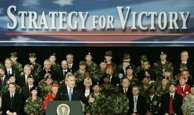
Leaving so soon? I guess the job is finished.
President Shrub will give a major speech Wednesday at the U.S. Naval Academy in Annapolis, Md., in which aides say he is expected to herald the improved readiness of Iraqi troops, which he has identified as the key condition for pulling out U.S. forces.
The administration's pivot on the issue comes as the White House is seeking to relieve enormous pressure by war opponents. The camp includes liberals, moderates and old-line conservatives who are uneasy with the costly and uncertain nation-building effort.
article
The administration's pivot on the issue comes as the White House is seeking to relieve enormous pressure by war opponents. The camp includes liberals, moderates and old-line conservatives who are uneasy with the costly and uncertain nation-building effort.
article
3/29/05
Here's this.
The top US general in Iraq authorised interrogation techniques including the use of dogs, stress positions and disorientation, a memo has shown.
The document was obtained by the American Civil Liberties Union through the US Freedom of Information Act.
The September 2003 document is signed by the then commander of US forces in Iraq, Gen Ricardo Sanchez.
The ACLU says the measures go beyond generally accepted practice and says Gen Sanchez should be made accountable.
The memo authorised techniques including putting prisoners in stressful positions, using loud music and light control, and changing sleeping patterns.
It also authorised the presence of muzzled military working dogs to, as the memo puts it, "exploit Arab fear of dogs while maintaining security during interrogations".
The presence of dogs and other measures, all of which required approval by Gen Sanchez, were rescinded a month later because of opposition from military lawyers.
Gen Sanchez says advance permission was required every time one of these techniques was requested, adding that he never gave such permission.
'Beyond army limits'
The Pentagon originally refused to release the memo on national security grounds, but passed it to the ACLU on Friday after the union challenged it in court under the Freedom of Information Act.
The ACLU says at least 12 of the 29 techniques listed in the document went far beyond limits established by the army's field manual.
"Gen Sanchez authorised interrogation techniques that were in clear violation of the Geneva Conventions and the army's own standards," ACLU lawyer Amrit Singh said in the union's statement.
"He and other high ranking officials who bear responsibility for the widespread abuse of detainees must be held accountable."
The techniques included "environmental manipulation" such as making a room hot or cold or using an "unpleasant smell", isolating a prisoner, and disrupting normal sleep patterns.
The memo also allowed the "false flag" technique of "convincing the detainee that individuals from a country other than the United States are interrogating him."
It was during Gen Sanchez's time as commander that Iraqi prisoners were abused by US troops at Baghdad's Abu Ghraib prison.
The cases - highlighted in photographs of hooded and naked inmates - sparked international outrage.
Army investigations have generally found that, where proven, abuses were not the result of policy set by senior leaders.
The ACLU is currently taking part in a lawsuit against Defence Secretary Donald Rumsfeld accusing him of responsibility for torture and abuse of detainees in US military custody in Iraq and Afghanistan.
Story from BBC NEWS
Published: 2005/03/30 04:24:23 GMT
The document was obtained by the American Civil Liberties Union through the US Freedom of Information Act.
The September 2003 document is signed by the then commander of US forces in Iraq, Gen Ricardo Sanchez.
The ACLU says the measures go beyond generally accepted practice and says Gen Sanchez should be made accountable.
The memo authorised techniques including putting prisoners in stressful positions, using loud music and light control, and changing sleeping patterns.
It also authorised the presence of muzzled military working dogs to, as the memo puts it, "exploit Arab fear of dogs while maintaining security during interrogations".
The presence of dogs and other measures, all of which required approval by Gen Sanchez, were rescinded a month later because of opposition from military lawyers.
Gen Sanchez says advance permission was required every time one of these techniques was requested, adding that he never gave such permission.
'Beyond army limits'
The Pentagon originally refused to release the memo on national security grounds, but passed it to the ACLU on Friday after the union challenged it in court under the Freedom of Information Act.
The ACLU says at least 12 of the 29 techniques listed in the document went far beyond limits established by the army's field manual.
"Gen Sanchez authorised interrogation techniques that were in clear violation of the Geneva Conventions and the army's own standards," ACLU lawyer Amrit Singh said in the union's statement.
"He and other high ranking officials who bear responsibility for the widespread abuse of detainees must be held accountable."
The techniques included "environmental manipulation" such as making a room hot or cold or using an "unpleasant smell", isolating a prisoner, and disrupting normal sleep patterns.
The memo also allowed the "false flag" technique of "convincing the detainee that individuals from a country other than the United States are interrogating him."
It was during Gen Sanchez's time as commander that Iraqi prisoners were abused by US troops at Baghdad's Abu Ghraib prison.
The cases - highlighted in photographs of hooded and naked inmates - sparked international outrage.
Army investigations have generally found that, where proven, abuses were not the result of policy set by senior leaders.
The ACLU is currently taking part in a lawsuit against Defence Secretary Donald Rumsfeld accusing him of responsibility for torture and abuse of detainees in US military custody in Iraq and Afghanistan.
Story from BBC NEWS
Published: 2005/03/30 04:24:23 GMT
Subscribe to:
Posts (Atom)